Art in the Years After the End of World War I Was
World State of war 2: Subsequently the War

At the stop of World War II, huge swaths of Europe and Asia had been reduced to ruins. Borders were redrawn and homecomings, expulsions, and burials were under way. But the massive efforts to rebuild had only begun. When the war began in the late 1930s, the world's population was approximately two billion. In less than a decade, the war between the Axis the Allied powers had resulted in 80 million deaths -- killing off about 4 percentage of the whole world. Allied forces at present became occupiers, taking command of Germany, Japan, and much of the territory they had formerly ruled. Efforts were fabricated to permanently dismantle the war-making abilities of those nations, as factories were destroyed and sometime leadership was removed or prosecuted. State of war crimes trials took place in Europe and Asia, leading to many executions and prison sentences. Millions of Germans and Japanese were forcibly expelled from territories they called home. Allied occupations and United nations decisions led to many long-lasting issues in the time to come, including the tensions that created East and West Germany, and divergent plans on the Korean Peninsula that led to the cosmos of Northward and South Korea and -- the Korean War in 1950. The United Nations Partition Program for Palestine paved the fashion for Israel to declare its independence in 1948 and marked the showtime of the continuing Arab-Israeli disharmonize. The growing tensions between Western powers and the Soviet Eastern Bloc developed into the Common cold War, and the evolution and proliferation of nuclear weapons raised the very real specter of an unimaginable World State of war 3 if common ground could not be found. World War II was the biggest story of the 20th Century, and its backwash continues to touch on the world profoundly more than 65 years later. (This entry is Part 20 of a weekly xx-part retrospective of Globe War 2)
Read more
Hints: View this page total screen. Skip to the next and previous photo past typing j/k or ←/→.
-
 Read more
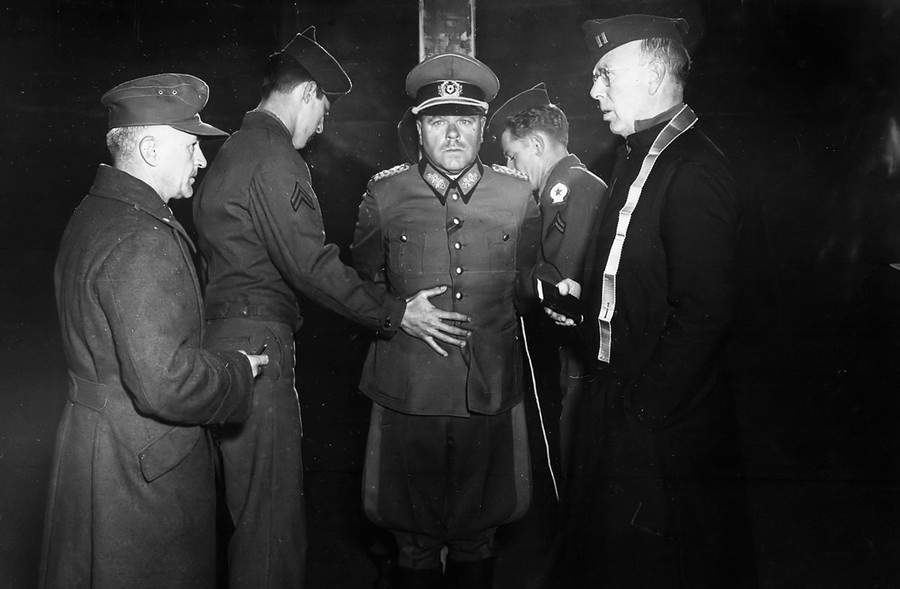
German Wehrmacht General Anton Dostler is tied to a stake before his execution by a firing squad in a stockade in Aversa, Italy, on December one, 1945. The general, the commander of the 75th Ground forces Corps, was sentenced to death by a United states of america military committee in Rome for having ordered the shooting of 15 unarmed American prisoners of war in La Spezia, Italia, on March 26, 1944. #
Associated Printing
-
-
 Read more
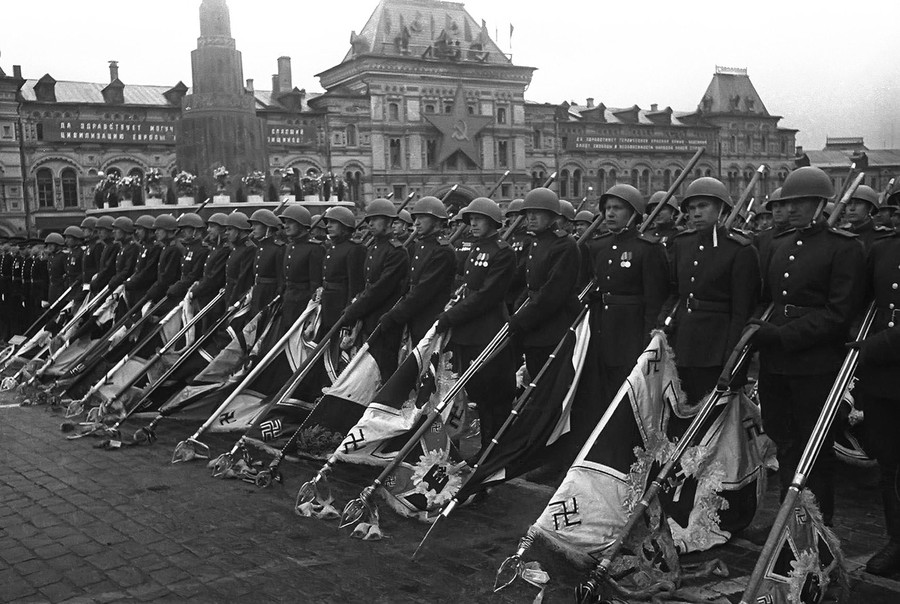
Soviet soldiers with lowered standards of the defeated Nazi forces during the Victory Solar day parade in Moscow, on June 24, 1945. #
-
 Read more than
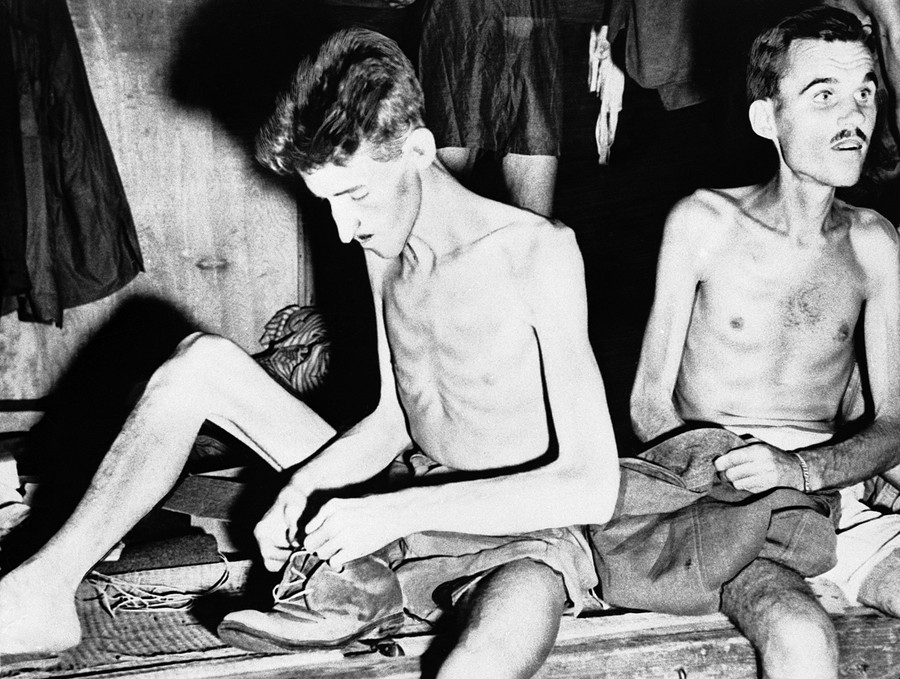
Gaunt and emaciated, but happy at their release from Japanese captivity, two Allied prisoners pack their meager property, afterwards beingness freed nigh Yokohama, Nihon, on September eleven, 1945, by men of an American mercy squadron of the U.S. Navy. #
AP Photo
-
 Read more
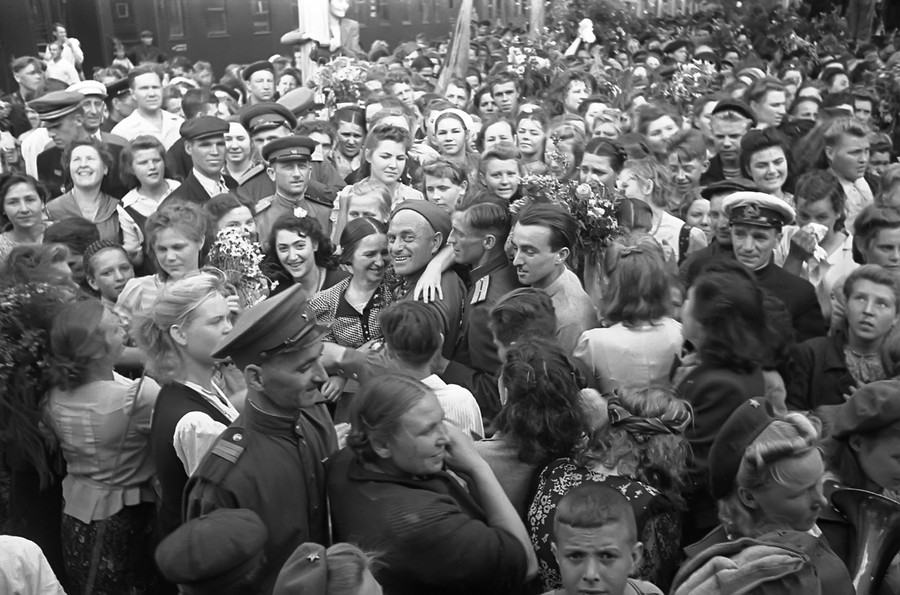
The return of victorious Soviet soldiers at a railway station in Moscow in 1945 #
-
 Read more
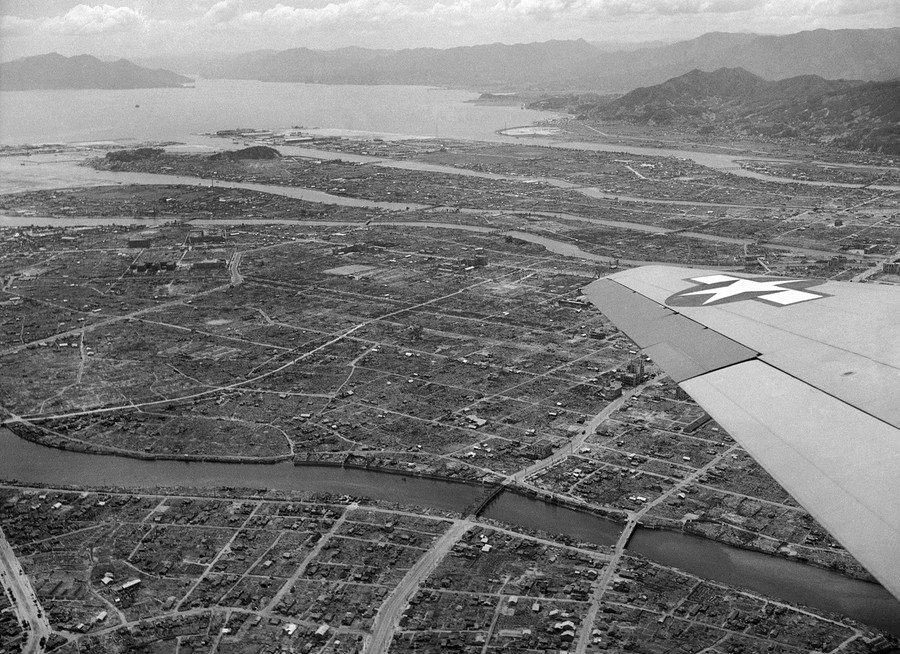
An aerial view of Hiroshima, Japan, one yr after the atomic-bomb blast shows some small corporeality of reconstruction amidst much ruin on July twenty, 1946. The deadening stride of rebuilding is attributed to a shortage of edifice equipment and materials. #
AP / Charles P. Gorry
-
 Read more
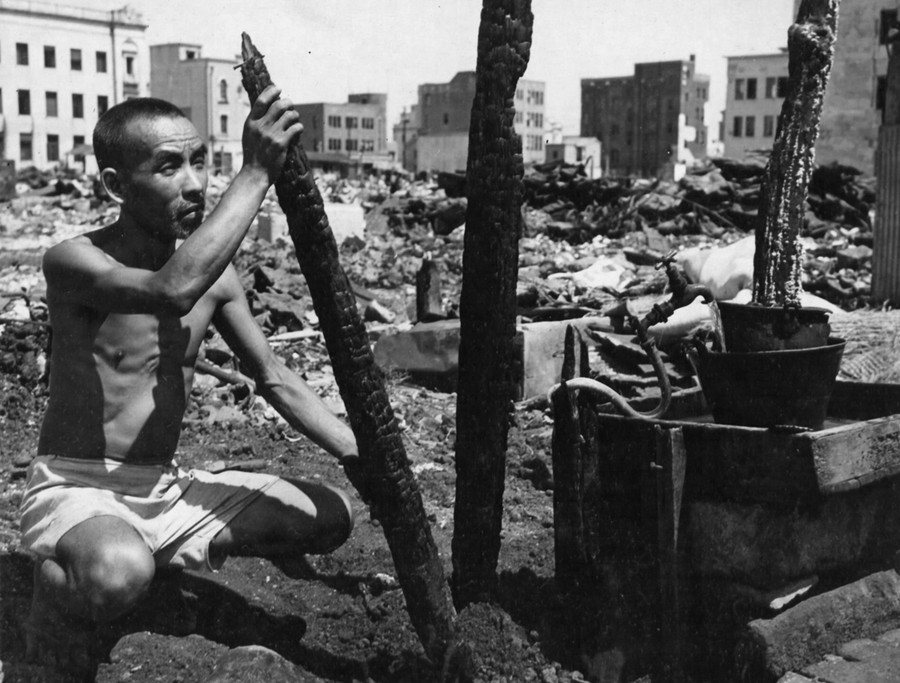
A Japanese human amid the scorched wreckage and rubble that was once his home in Yokohama, Japan #
NARA
-
-
 Read more than
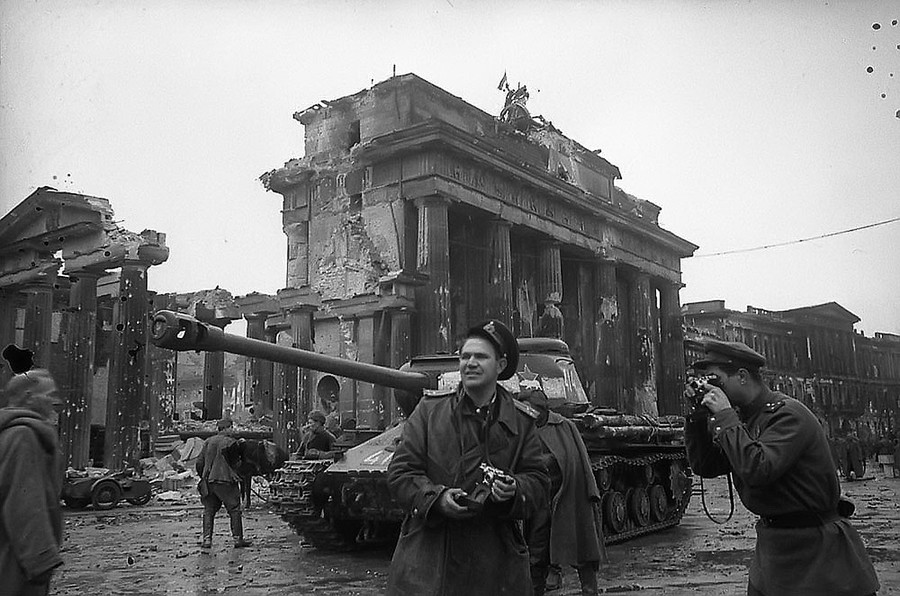
The Scarlet Army photographer Yevgeny Khaldei (center) in Berlin with Soviet forces, virtually the Brandenburg Gate in May 1945. #
-
 Read more
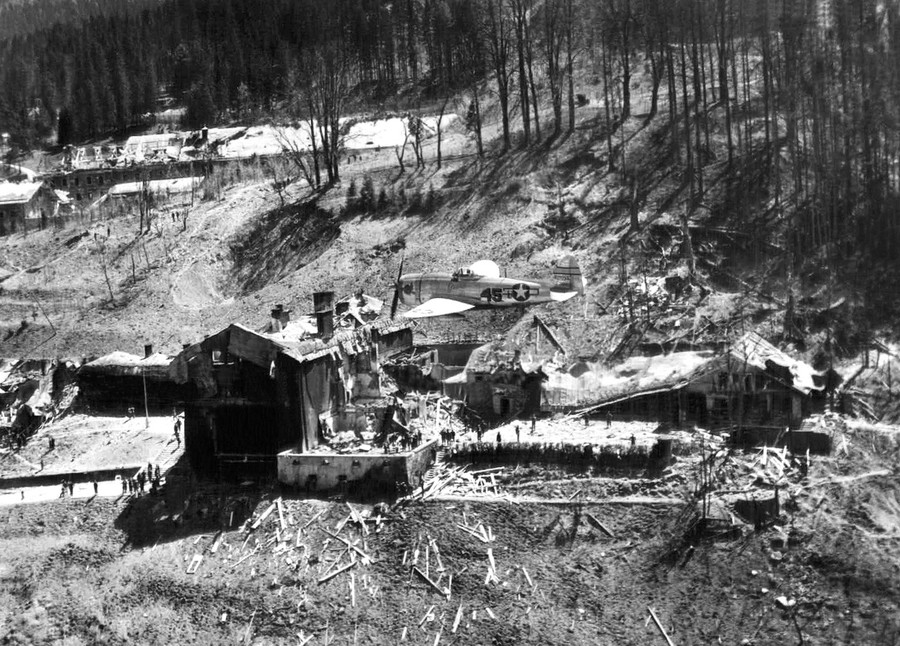
A P-47 Thunderbolt of the U.Southward. Army Twelfth Air Force flies low over the crumbled ruins of what once was Hitler's retreat at Berchtesgaden, Frg, on May 26, 1945. Pocket-size and large bomb craters dot the grounds around the wreckage. #
Associated Press
-
 Read more
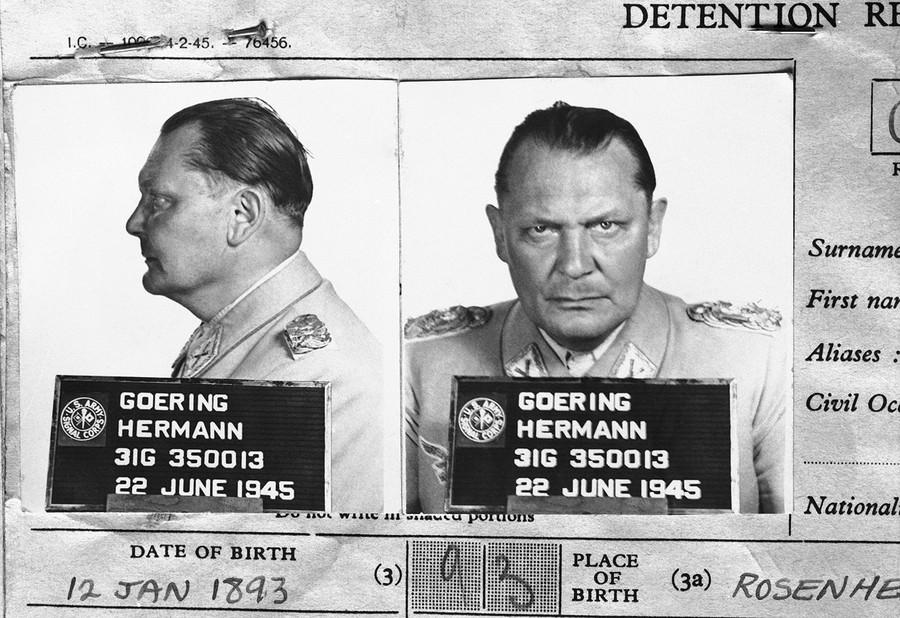
Hermann Göring, once the leader of the formidable Luftwaffe and the second in command of the German Reich under Hitler, appears in a mugshot on file with the Central Registry of War Criminals and Security Suspects in Paris, France, on November five, 1945. Göring surrendered to U.S. soldiers in Bavaria, on May 9, 1945, and was eventually taken to Nuremberg to face up trial for war crimes. #
Associated Press
-
 Read more
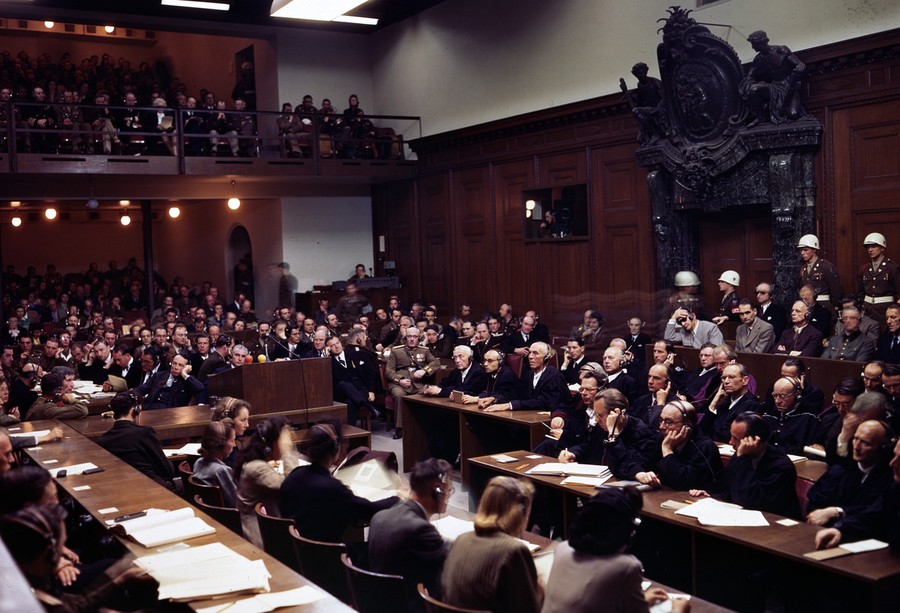
The interior of the courtroom of the Nuremberg trials in 1946 during the Trial of the Major War Criminals, prosecuting 24 authorities and civilian leaders of Nazi Federal republic of germany. Visible here is Hermann Göring, the former leader of the Luftwaffe, seated in the box at center correct, wearing a greyness jacket, headphones, and night spectacles. Next to him sits Rudolf Hess, the former Deputy Führer of Germany; then Joachim von Ribbentrop, the former Nazi Minister of Strange Affairs; Wilhelm Keitel, the former leader of Germany's Supreme Command (blurry face); and Ernst Kaltenbrunner, the highest ranking surviving SS-leader. Göring, von Ribbentrop, Keitel, and Kaltenbrunner were sentenced to death by hanging along with 8 others—Göring died by suicide the night before the execution. Hess was sentenced to life imprisonment, which he served at Spandau Prison, Berlin, until he died in 1987. #
AP / STF
-
 Read more
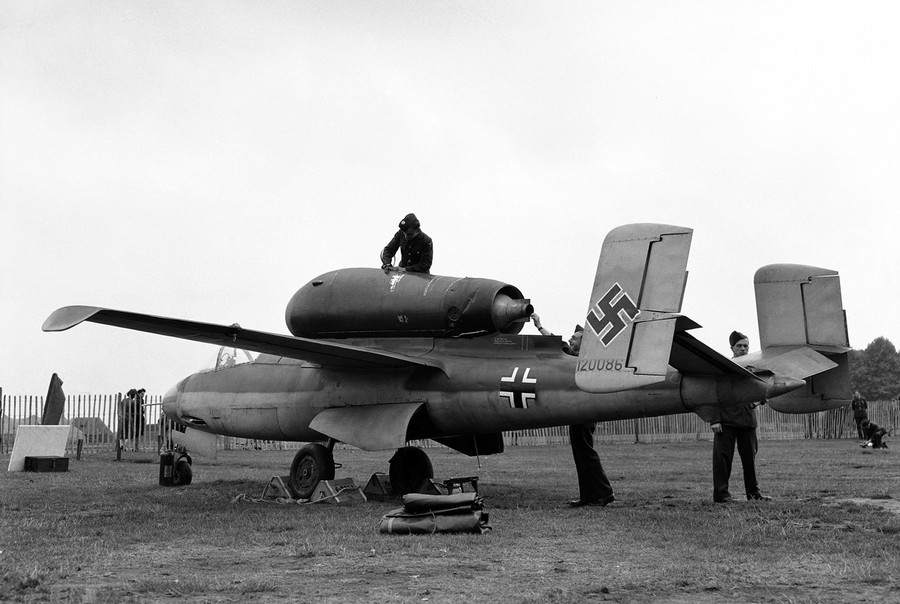
Many of Frg's captured new and experimental aircraft were displayed in an exhibition as role of London's Thanksgiving week on September fourteen, 1945. Amid the aircraft are a number of jet- and rocket-propelled planes. Pictured here is a side view of the Heinkel He-162 "Volksjäger," propelled by a turbo-jet unit mounted in a higher place the fuselage, in Hyde Park, London. #
Associated Press
-
-
 Read more than
One year after the D-24-hour interval landings in Normandy, High german prisoners landscape the kickoff U.South. cemetery at Saint-Laurent-sur-Mer, France, near Omaha Beach, on May 28, 1945. #
AP / Peter J. Carroll
-
 Read more
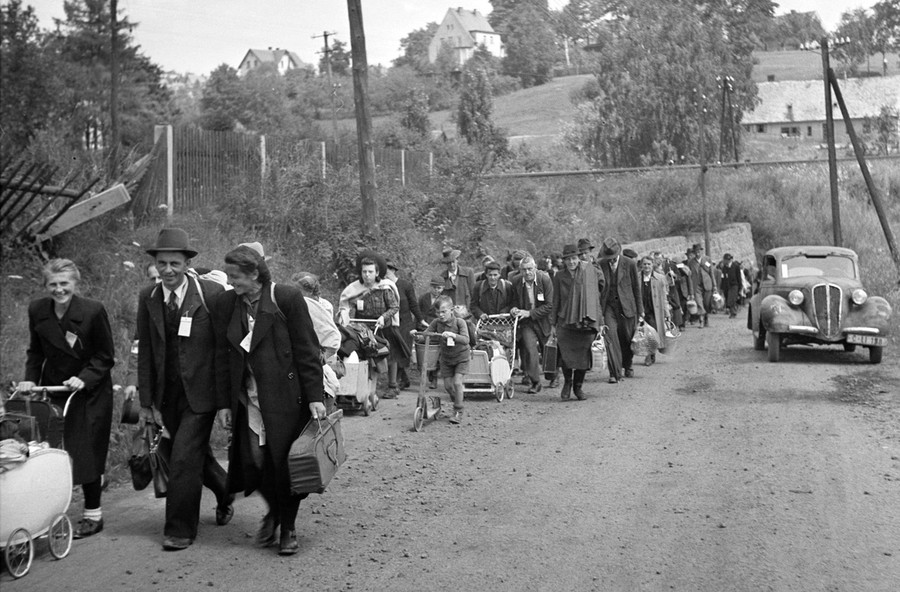
Sudeten Germans brand their mode to the railway station in Liberec, in former Czechoslovakia, to exist transferred to Federal republic of germany in this July 1946 photo. Afterwards the end of the state of war, millions of German nationals and ethnic Germans were forcibly expelled from both territory Frg had annexed and formerly German lands that were transferred to Poland and the Soviet Union. The estimated numbers of Germans involved ranges from 12 to fourteen one thousand thousand, with a further estimate of 500,000 to two million dying during the expulsion. #
AP / CTK
-
 Read more
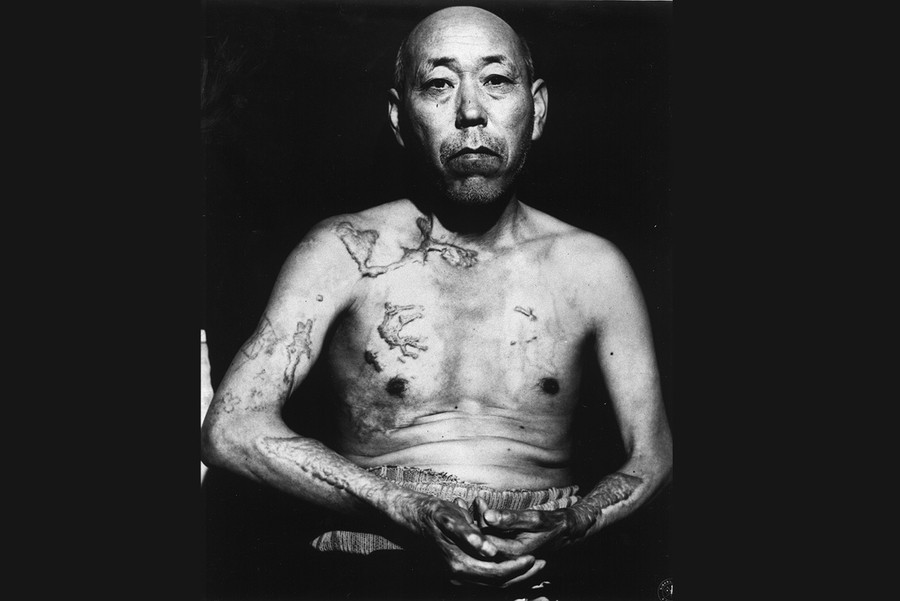
A survivor of the starting time atomic bomb ever used in warfare, Jinpe Teravama retains scars later on the healing of burns from the bomb explosion in Hiroshima, in June 1947. #
Associated Press
-
 Read more
Disabled buses that have littered the streets of Tokyo are used to aid relieve the astute housing shortage in the Japanese upper-case letter on October two, 1946. Japanese who hauled the buses into a vacant lot are converting them into homes for their families. #
AP / Charles Gorry
-
 Read more
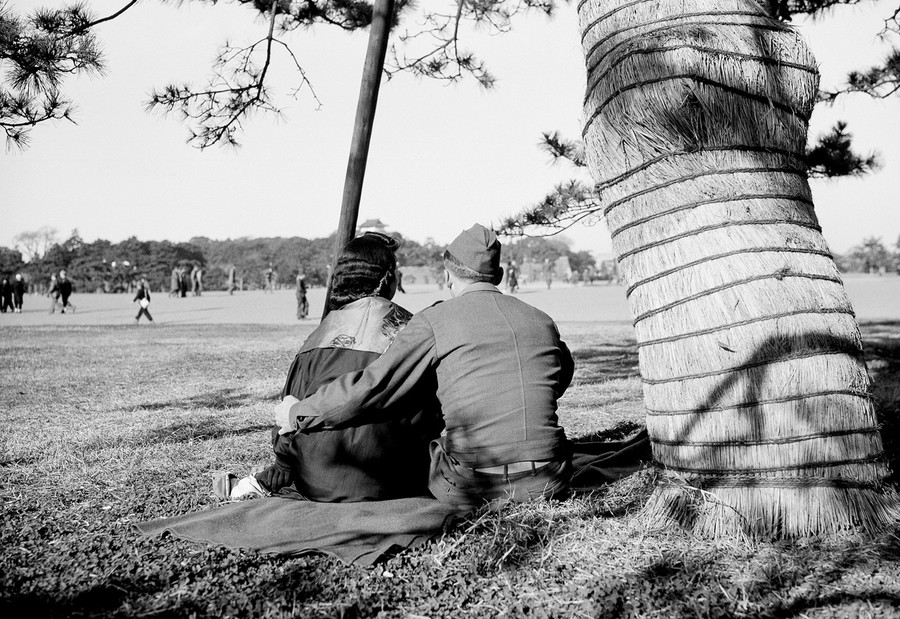
An American G.I. places his arm around a Japanese girl as they view the surround of Hibiya Park, near the Tokyo palace of the emperor, on January 21, 1946. #
AP / Charles Gorry
-
-
 Read more
This is an aeriform view of the city of London around St. Paul's Cathedral showing bomb-damaged areas in April 1945. #
Associated Press
-
 Read more
General Charles de Gaulle (center) shakes easily with children, two months after the High german capitulation in Lorient, France, in July 1945. Lorient was the location of a German U-boat (submarine) base during World War 2. From Jan fourteen to February 17, 1943, as many as 500 high-explosive aerial bombs and more than lx,000 incendiary bombs were dropped on Lorient. The city was almost completely destroyed, with well-nigh xc percent of the city flattened. #
AFP / Getty
-
 Read more
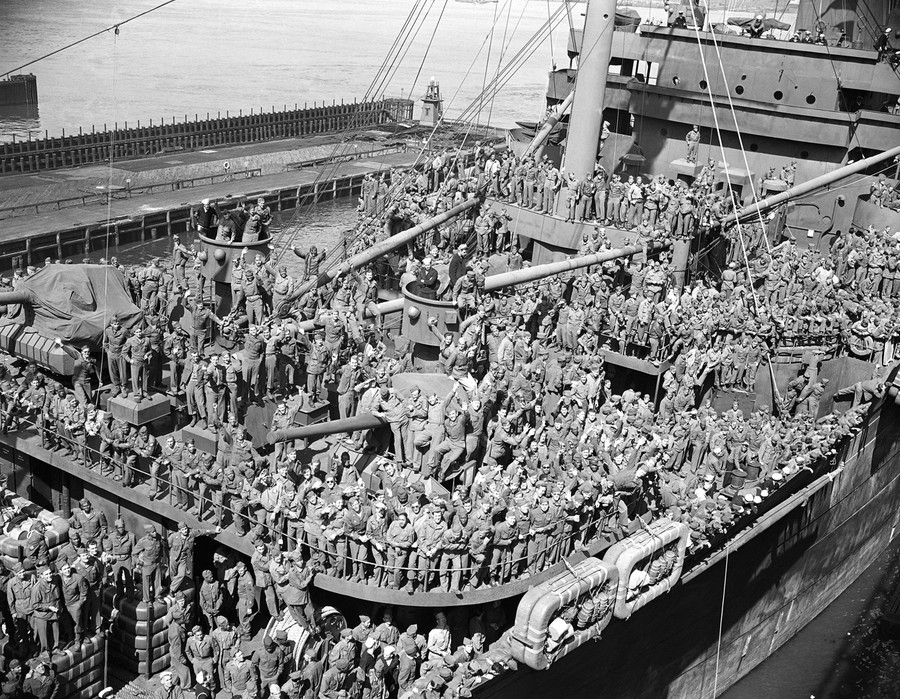
The super ship ship Full general W. P. Richardson, docked in New York, with veterans of the European state of war cheering on June 7, 1945. Many soldiers were veterans of the African campaign, Salerno, Anzio, Cassino, and the winter warfare in Italian republic's mountains. #
AP / Tony Camerano
-
 Read more than
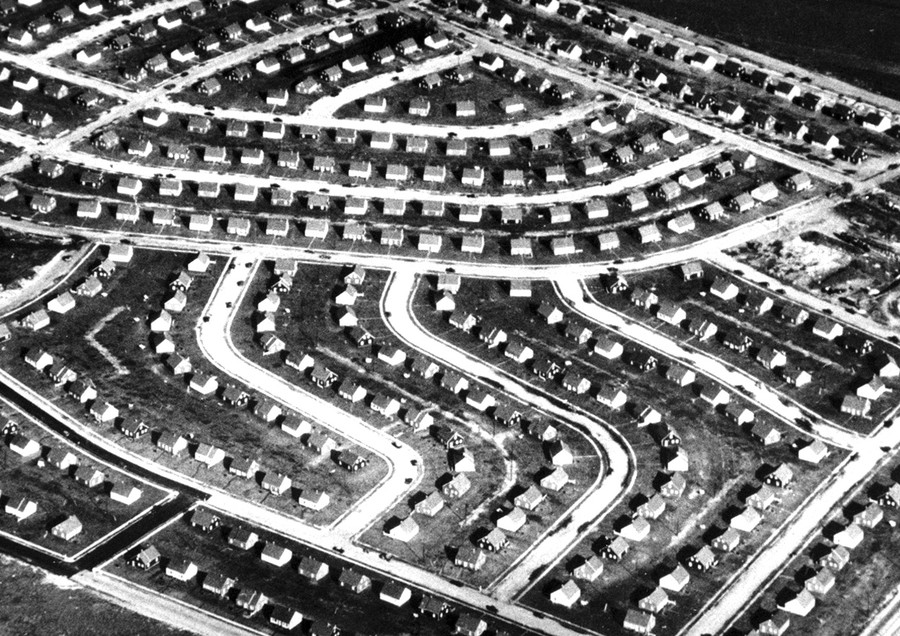
This aerial file photo shows a portion of Levittown, New York, in 1948 shortly after the mass-produced suburb was completed on Long Isle farmland. This prototypical suburban customs was the starting time of many mass-produced housing developments that went up for soldiers returning home from Earth War Two. It also became a symbol of postwar suburbia in the U.S. #
AP / Levittown Public Library, File
-
 Read more
This idiot box, retailing for $100, is reportedly the first moderately priced receiver manufactured in quantity. Rose Clare Leonard watches the screen, which reproduces a 5-by-7-inch epitome, every bit she tunes in at the beginning public postwar showing at a New York department store, on August 24, 1945. Although television receiver was invented prior to Earth War Ii, the war prevented mass product. Before long later the war, sales and product picked up, and by 1948, regular commercial network programming had begun. #
AP / Ed Ford
-
-
 Read more
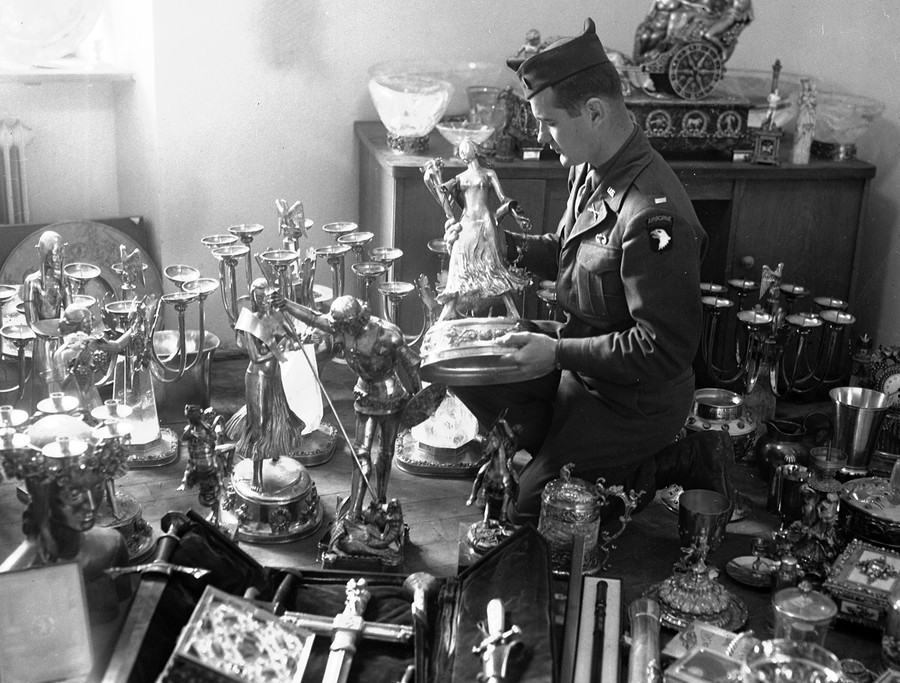
A U.Southward. soldier examines a solid-gold statue, function of Hermann Göring's private loot, establish by the seventh U.Southward. Army in a mountainside cave near Schönau am Königssee, Germany, on May 25, 1945. The secret cave, the 2d institute to date, also contained stolen priceless paintings from all over Europe. #
AP / Jim Pringle
-
 Read more
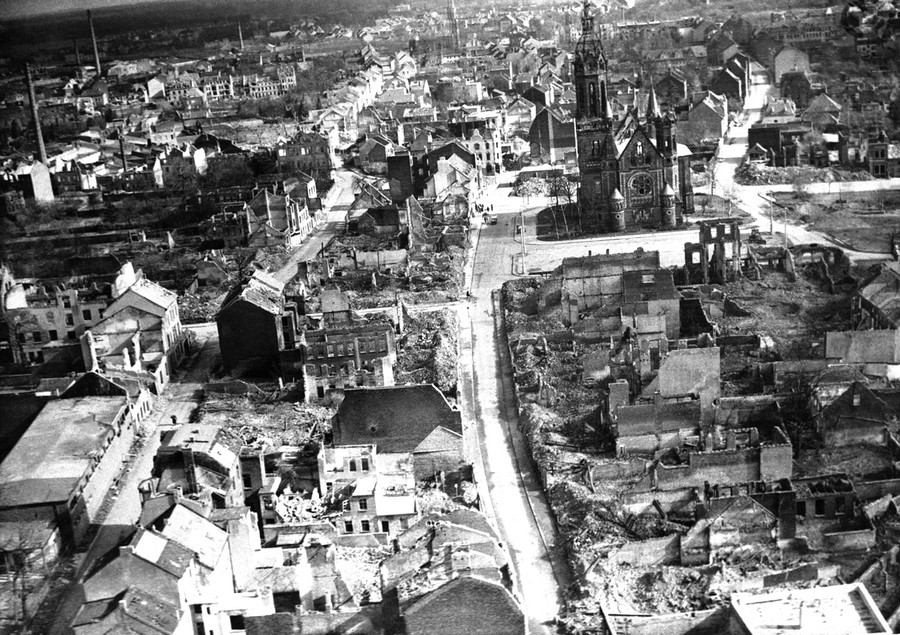
In Europe, some churches accept been completely ruined, but others however stand amidst utter devastation. Mönchengladbach Cathedral stands here in the rubble, though nevertheless in need of repairs, seen in Germany, on November twenty, 1945. #
Associated Press
-
 Read more
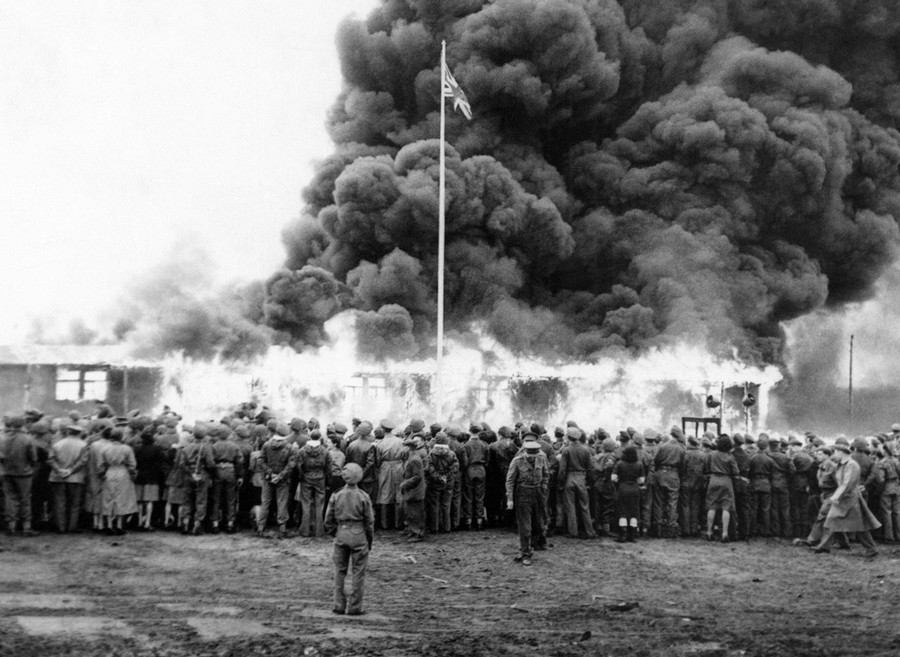
On May 21, Colonel Bird, the Commandant of Belsen Military camp, gave the society for the last hut at Belsen Concentration Campsite to be burned. A rifle salute was fired in honour of the dead, and the British flag was run upward at the aforementioned moment as a flame-thrower fix fire to the last hut. A German flag and a portrait of Hitler went up in flames inside the hut in June 1945. #
AP / British Official Photo
-
 Read more
German mothers walk their children to school through the streets of Aachen, Germany, on June 6, 1945, for registration at the first public school to be opened by the U.S. armed services government after the war. #
AP / Peter J. Carroll
-
 Read more
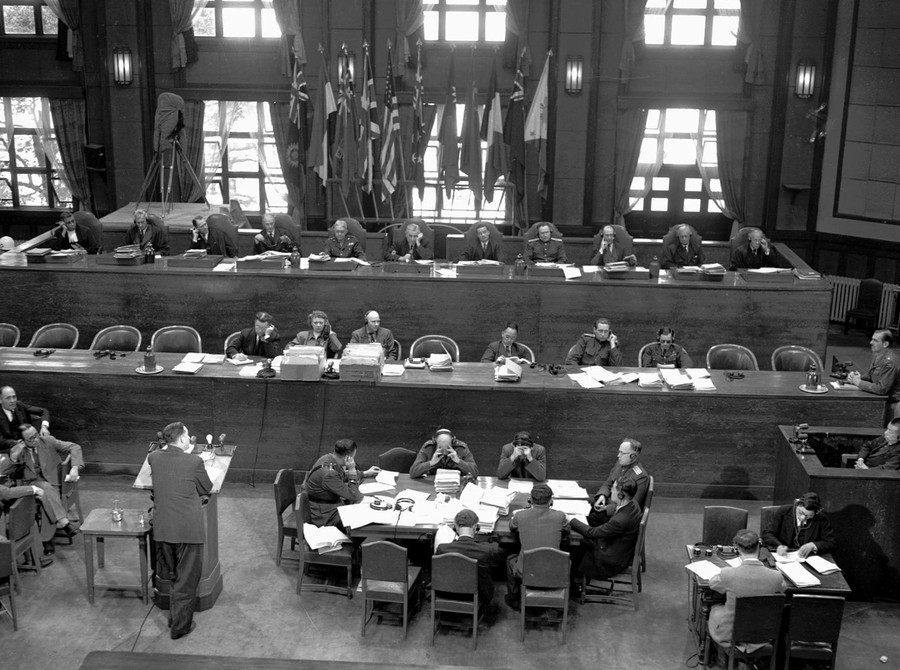
A full general view of the International War machine Tribunal for the Far East meeting in Tokyo in April 1947. On May three, 1946, the Allies began the trial of 28 Japanese civilian and military leaders for war crimes. Seven were hanged, and others were sentenced to prison terms. #
Associated Press
-
-
 Read more
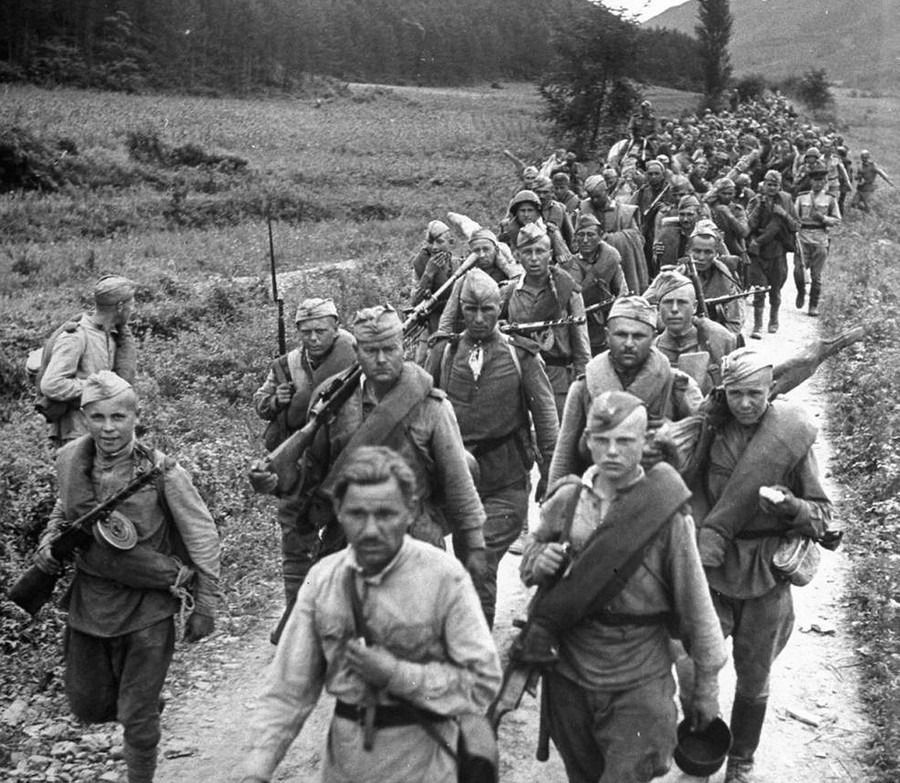
Soviet soldiers are on the march in northern Korea in October 1945. Japan had ruled the Korean peninsula for 35 years, until the terminate of Earth State of war Ii. At that time, Allied leaders decided to temporarily occupy the country until elections could be held and a government established. Soviet forces occupied the north, while U.South. forces occupied the south. The planned elections did not take place, as the Soviet Union established a communist country in North korea, and the U.Southward. ready a pro-western state in South Korea—each claiming to be sovereign over the unabridged peninsula. This standoff led to the Korean War in 1950, which concluded in 1953 with the signing of an armistice, but to this day, the two countries are withal technically at war with each other. #
-
 Read more than
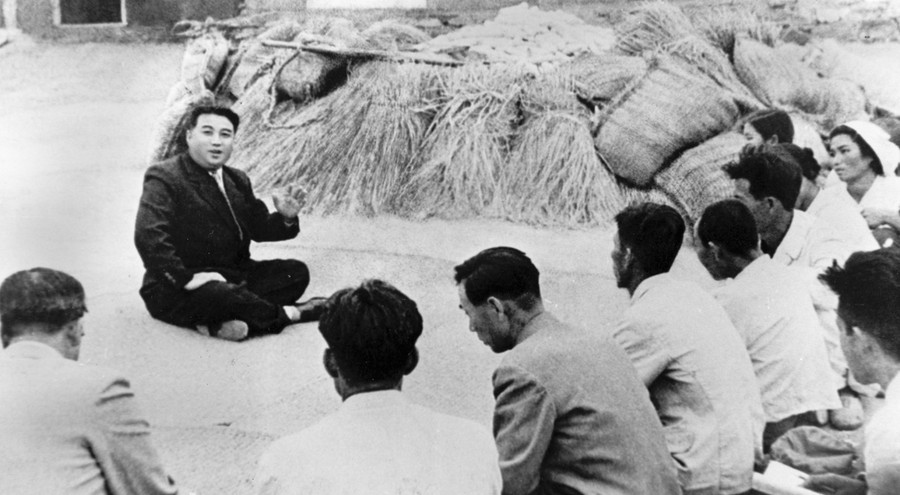
In this October 1945 photo from Democratic people's republic of korea's official Korean Cardinal News Agency, communist leader Kim Il-sung chats with a farmer from Qingshanli, Kangso Canton, South Pyongyang in North Korea. #
Korean Key News Bureau / Korea News Service via AP
-
 Read more than
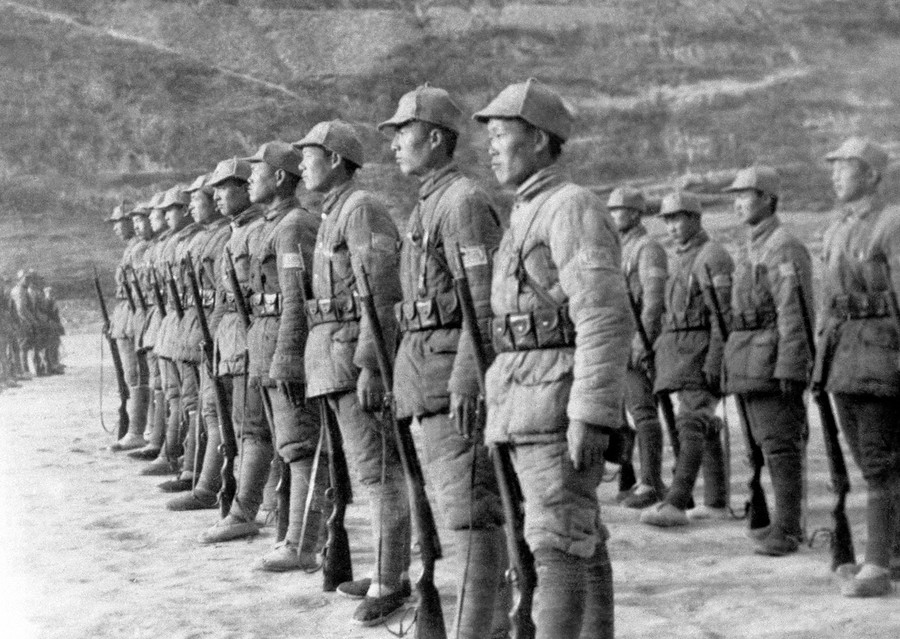
Soldiers of the Chinese Communist Eighth Route Army on the drill field at Yanan, the capital of a huge expanse in northward China that is governed by the Chinese Communist Party (CPC), seen on March 26, 1946. These soldiers are members of the "Night Tiger" battalion. The CPC had waged war against the ruling Kuomintang (KMT, or Chinese Nationalist Political party) since 1927, vying for control of China. Japanese invasions during World War II forced the 2 sides to put most of their struggles aside to fight a common foreign foe—though they did still fight each other from time to time. After the war ended, and the Soviet Union pulled out of Manchuria, a total-calibration civil war erupted in China in June 1946. The KMT eventually was defeated, with millions retreating to Taiwan, as CPC leader Mao Zedong established the People's Republic of China in 1949. #
Associated Press
-
 Read more
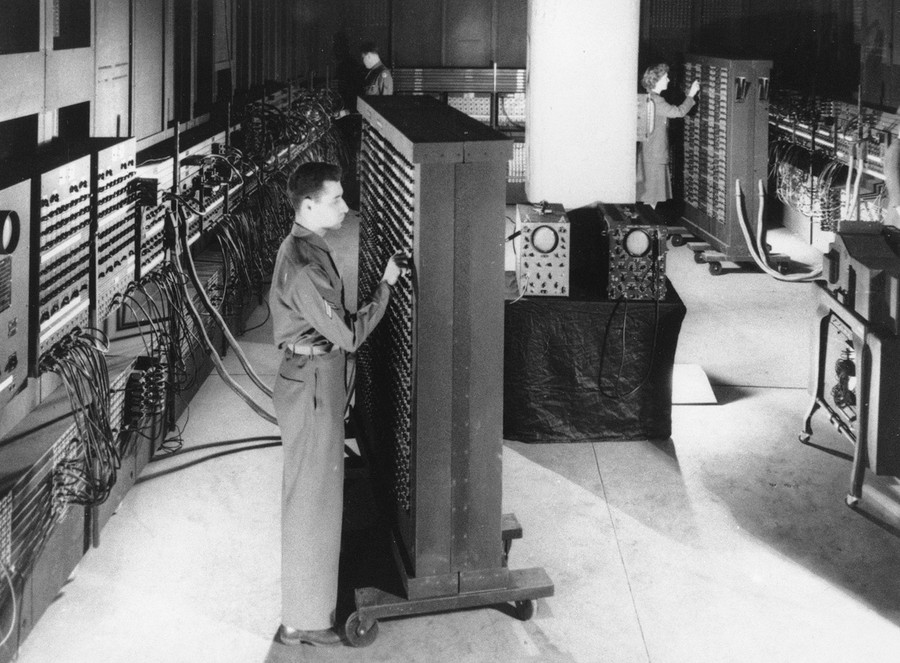
This 1946 photograph shows the Electronic Numerical Integrator And Figurer, or ENIAC, the commencement full general-purpose electronic estimator—a xxx-ton machine housed at the University of Pennsylvania. Developed in cloak-and-dagger starting in 1943, ENIAC was designed to calculate artillery-firing tables for the United States Army'southward Ballistic Inquiry Laboratory. The completed machine was announced to the public on February fourteen, 1946. The inventors of ENIAC promoted the spread of the new technologies through a serial of influential lectures on the structure of electronic digital computers at the University of Pennsylvania in 1946, known as the Moore School Lectures. #
Associated Printing
-
 Read more
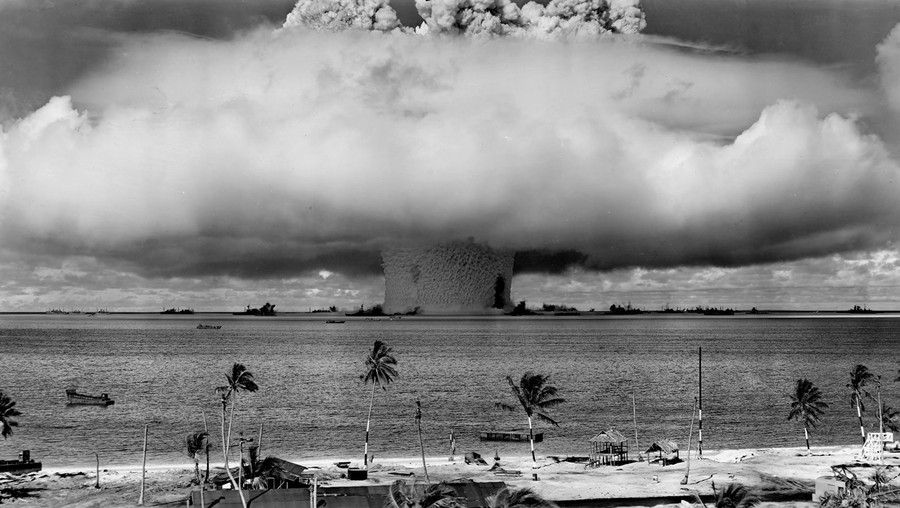
A test nuclear explosion codenamed "Baker," part of Functioning Crossroads, at Bikini Atoll in the Republic of the marshall islands, on July 25, 1946. The xl-kiloton diminutive bomb was detonated by the U.South. at a depth of 27 meters beneath the ocean surface, 3 and a half miles from the atoll. The purpose of the tests was to study the effects of nuclear explosions on ships. Seventy-three ships were gathered to the spot—both obsolete American and captured ships, including the Japanese battleship Nagato. #
NARA
-
-
 Read more
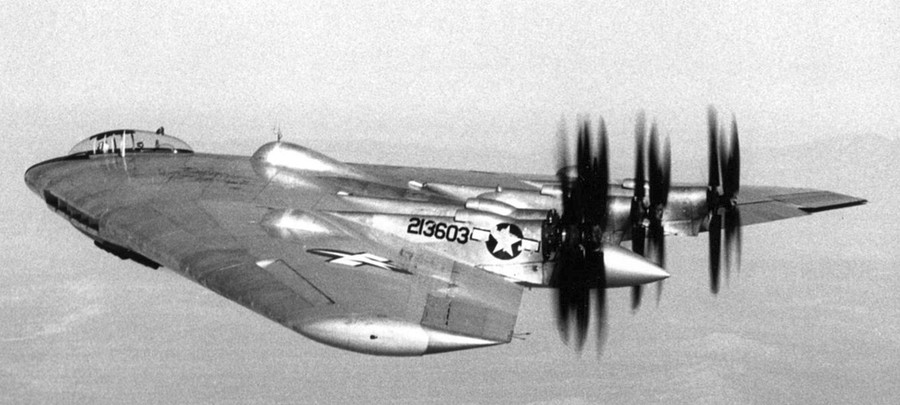
Northrop'south Flying Wing Bomber known as the XB-35 in flying in 1946. The XB-35 was an experimental heavy bomber developed for the U.Due south. Army Air Strength during World War II. The projection was terminated shortly afterwards the war because of technical difficulties. #
Associated Press
-
 Read more
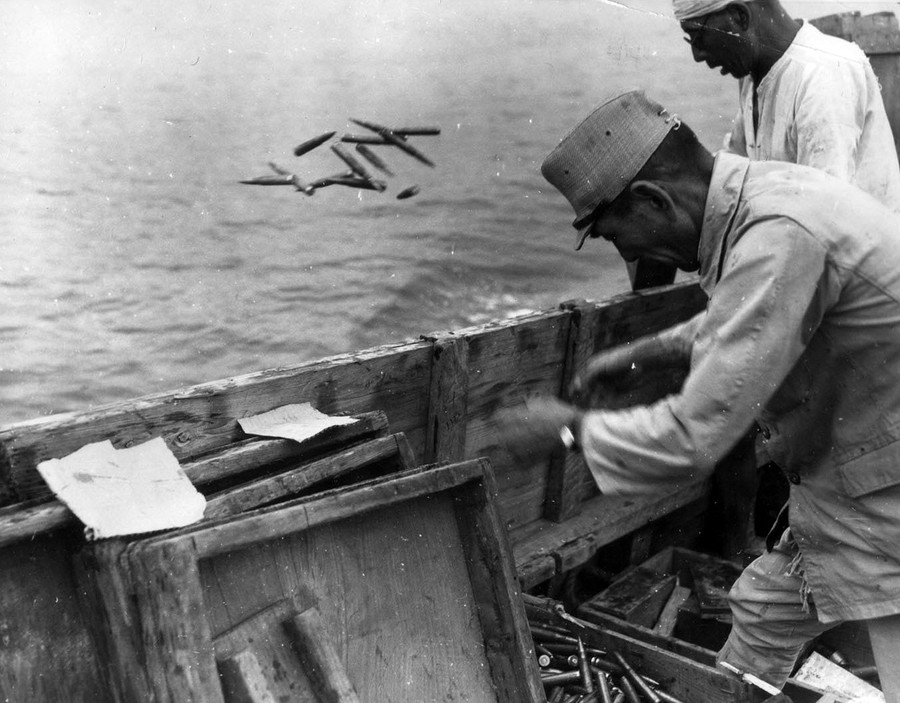
Japanese ammunition being dumped into the body of water on September 21, 1945. During the U.S. occupation, most all of the Japanese war industry and existing ammunition was dismantled. #
U.S. Army
-
 Read more
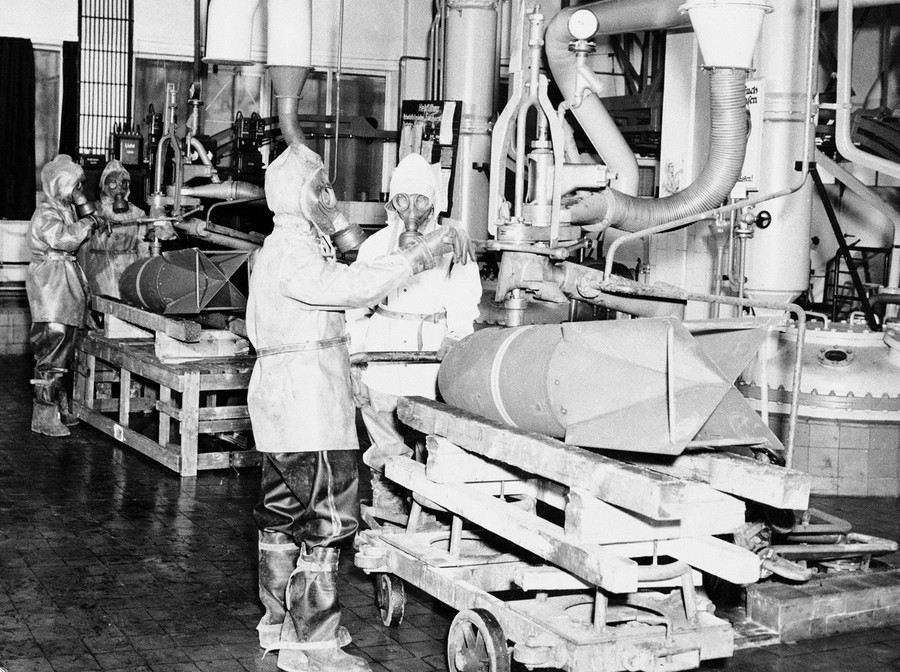
These unidentified German workers in decontamination article of clothing destroy toxic bombs on June 28, 1946, at the U.South. Ground forces Chemical Warfare Service Depot, at St. Georgen, Germany. The devastation and disposal of 65,000 dead-weight tons of German toxics, including mustard gas, was accomplished in one of two ways: called-for or dumping the empty shells and bombs into the Northward Sea. #
Associated Press
-
 Read more than
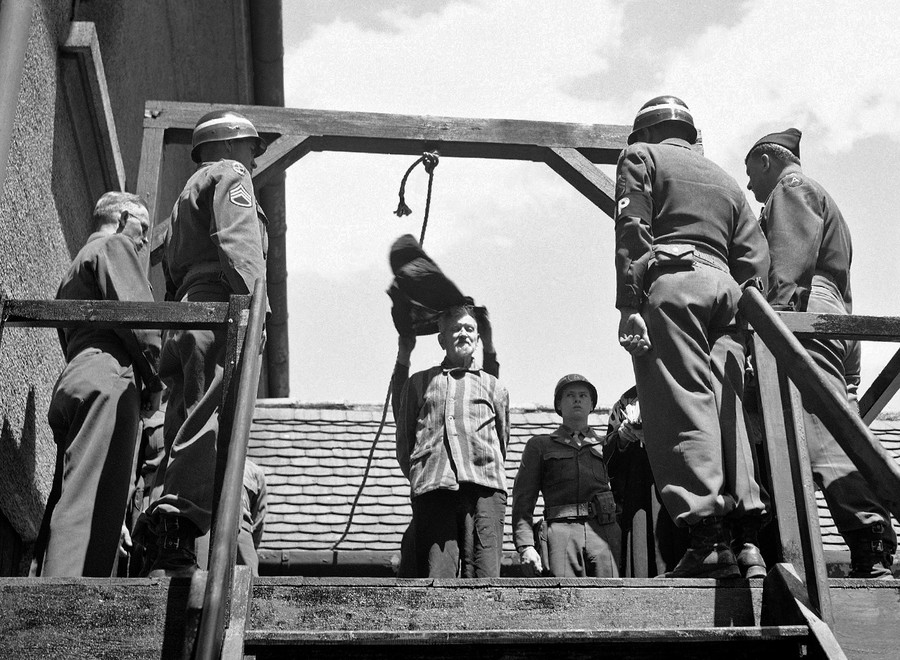
U.S. military authorities prepare to hang Dr. Klaus Karl Schilling, 74, at Landsberg, Germany, on May 28, 1946. In a Dachau war-crimes trial, he was convicted of using 1,200 concentration-camp prisoners for malaria experimentation. Xxx died directly from the inoculations and 300 to 400 died later from complications of the disease. His experiments, all with unwilling subjects, began in 1942. #
AP / Robert Clover
-
 Read more
The new cemetery at Belsen, Germany, on March 28, 1946, where 13,000 people who died later on the Belsen concentration camp was liberated are buried. #
Associated Press
-
-
 Read more
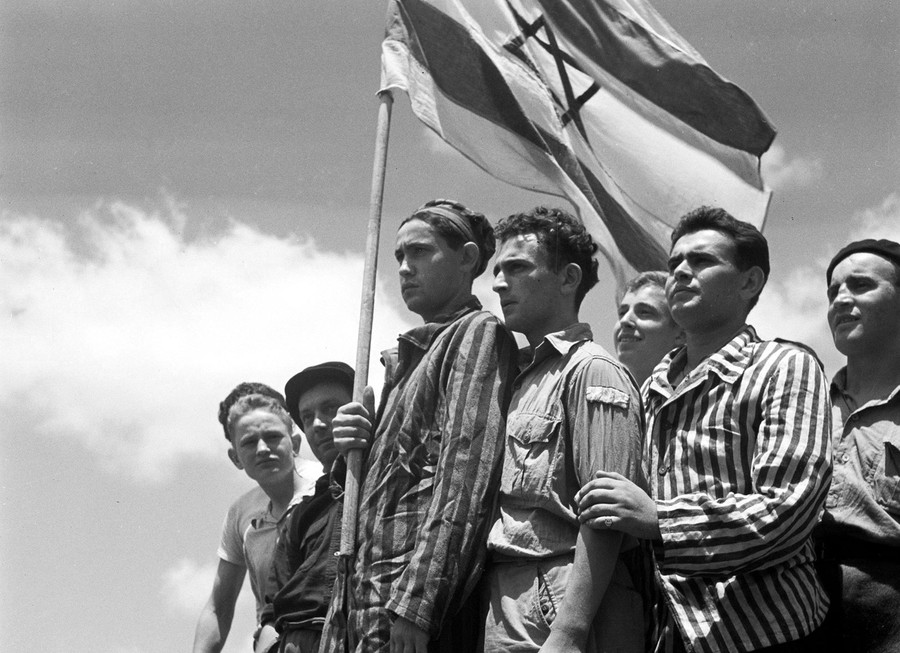
Jewish survivors of the Buchenwald Nazi concentration military camp, some still in their camp article of clothing, stand up on the deck of the refugee immigration transport Mataroa, on July 15, 1945, at Haifa Port, during the British Mandate of Palestine, in what would subsequently become the israel. During World War Ii, millions of Jews were fleeing Federal republic of germany and its occupied territories, many attempting to enter the British Mandate of Palestine, despite tight restrictions on Jewish immigration established by the British in 1939. Many of these would-be immigrants were caught and rounded up into detention camps. In 1947, Britain appear plans to withdraw from the territory, and the United Nations canonical the Partition Plan for Palestine, establishing a Jewish and a Palestinian country in the country. On May 14, 1948, Israel declared independence and was immediately attacked by neighboring Arab states, beginning the Arab-Israeli conflict that continues to this day. #
Zoltan Kluger / GPO via Getty
-
 Read more
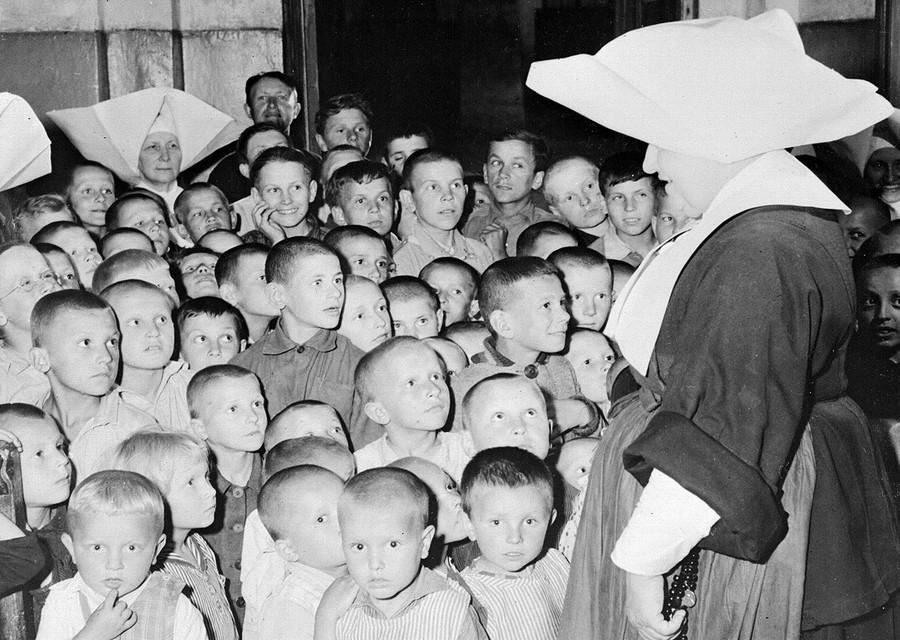
Some of Poland's thousands of state of war orphans at a Catholic orphanage in Lublin, on September 11, 1946, where they were being cared for past the Polish Red Cross. Most of the clothing, as well as vitamins and medicines, were provided by the American Ruby Cantankerous. #
Associated Press
-
 Read more
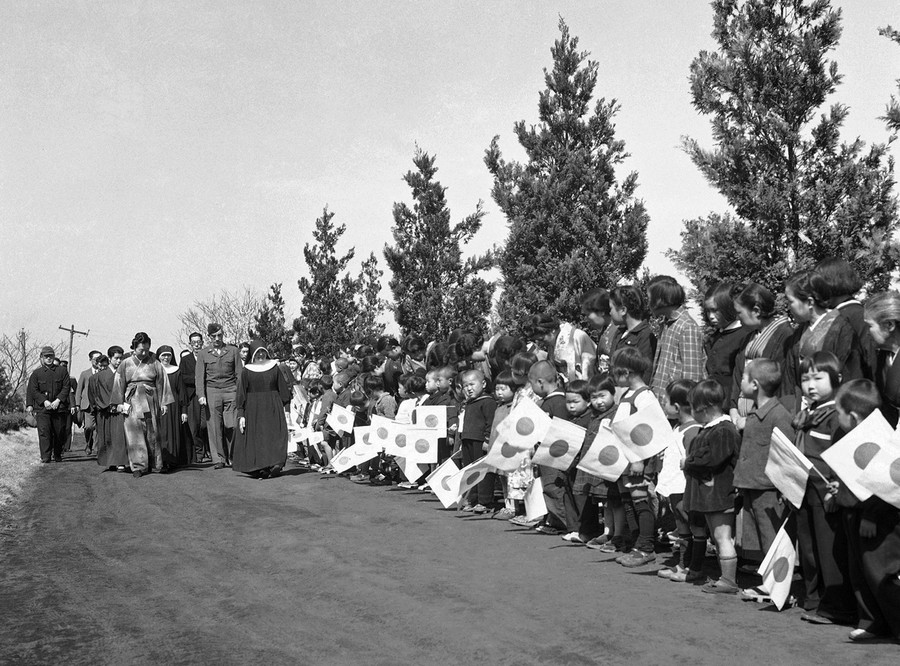
The Empress of Nihon visits a Catholic orphanage staffed past Japanese nuns for children who have lost their parents in the state of war and air raids over Tokyo. The empress inspected the grounds and paid a visit to the chapel. Children moving ridge Japanese flags to greet the empress during her visit in Fujisawa in Tokyo, on April 13, 1946. #
Associated Press
-
 Read more
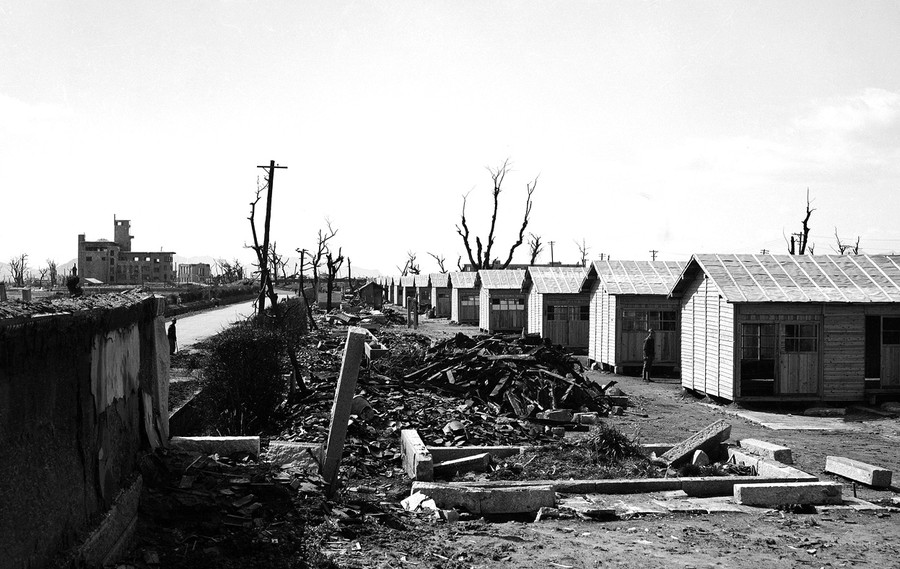
New buildings (right) rise out of the ruins of Hiroshima, Japan, on March eleven, 1946. These single-story homes congenital along a hard-surfaced highway are part of the program past the Japanese government to rebuild devastated sections of the land. At left background are damaged buildings whose masonry withstood the effects of the kickoff atomic bomb always detonated every bit a weapon. #
AP / Charles P. Gorry
-
 Read more
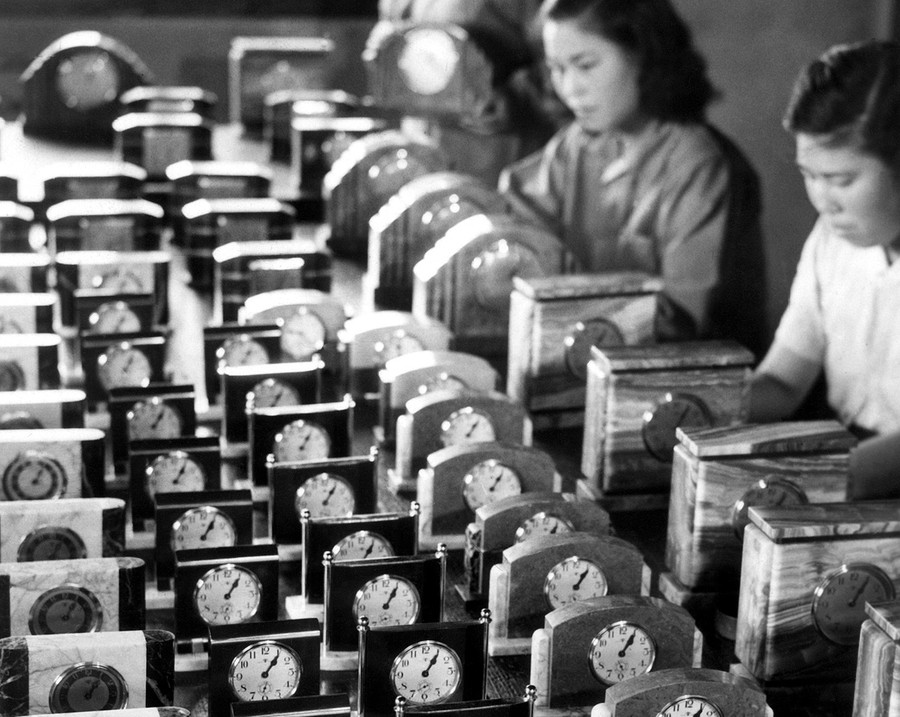
Clocks are being readied for export to Centrolineal countries, shown as collateral for imported goods needed by Nihon. Thirty-four Japanese factories produced 123,000 clocks during April 1946. Photo taken on June 25, 1946. #
AP / Charles Gorry
-
-
 Read more
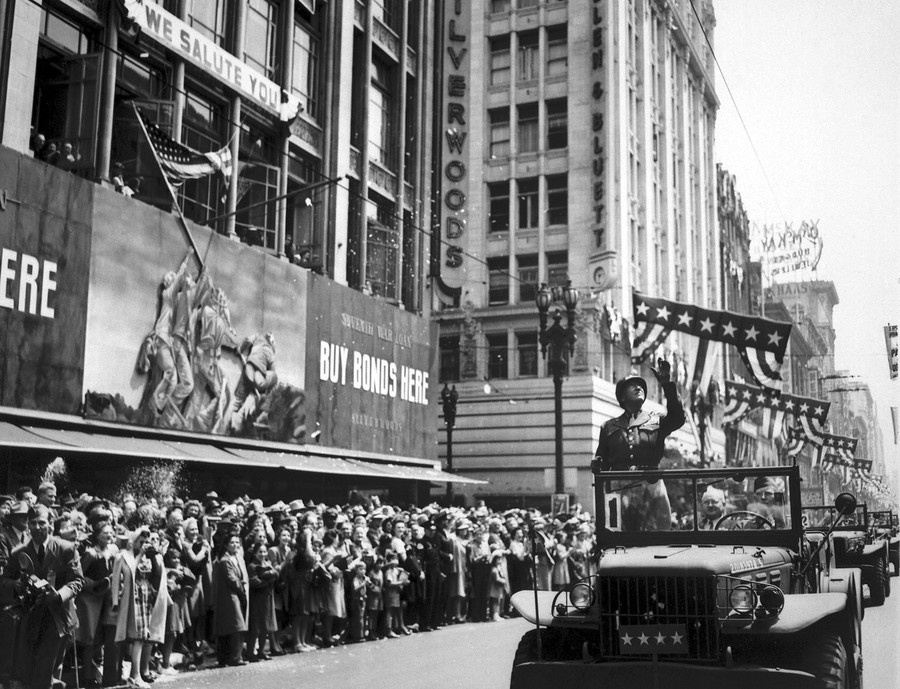
U.Southward. General George Southward. Patton acknowledges the thank you of thousands during a parade through downtown Los Angeles on June ix, 1945. Shortly thereafter, Patton returned to Germany and controversy, as he advocated for the employment of ex-Nazis in administrative positions in Bavaria; he was relieved of command of the 3rd Regular army and died of injuries from a traffic blow in December, later on his return abode. Joe Rosenthal's famous Iwo Jima flag-raising photo is visible on the war-bonds billboard. #
Associated Printing
-
 Read more
This 1945 photo shows High german women clearing up the debris on Berlin's Tauentzienstrasse, with the ruins of the Kaiser Wilhelm Church in the background. The absence of able-bodied men meant that the responsibility for clearing the wreckage fell mainly to civilian women, which were chosen "Truemmerfrauen," or rubble ladies. The signs on the left marking the edge between the British-occupied sector and the U.Due south. sector of the city. #
Associated Press
-
 Read more
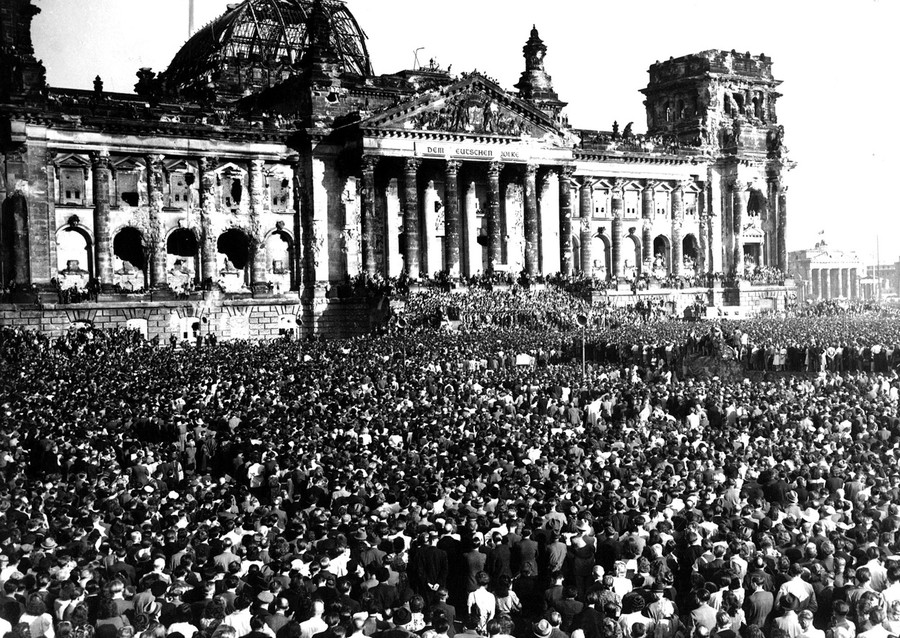
The scene in Berlin's Republic Square, earlier the ruined Reichstag Edifice, on September 9, 1948, as anti-communists, estimated at a quarter of a million, scream their opposition to communism. At the time, the Soviet Union was enforcing the Berlin Blockade, preventing Allied access to the parts of Berlin under Centrolineal control. In response, Allies began the Berlin Airlift until the Soviets lifted the blockade in 1949, and E Germany and West Germany were established. When the meeting pictured here bankrupt up, a series of incidents between anti-Red Germans and Soviet troops brought tension to a fever pitch as shootings took place, resulting in the deaths of 2 Germans. #
Associated Printing
-
 Read more than
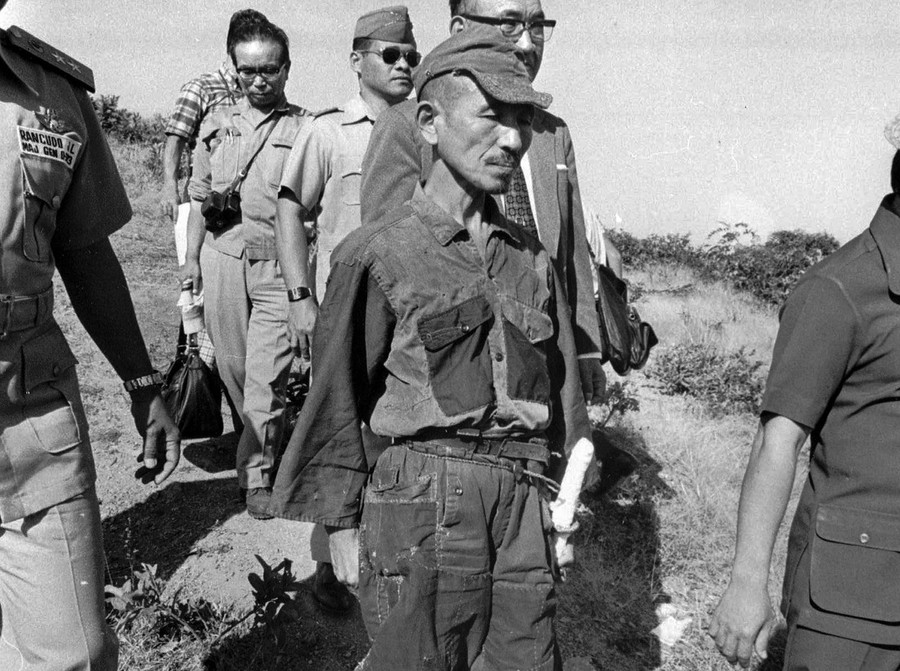
In March 1974, some 29 years later the official end of World War Ii, Hiroo Onoda, a erstwhile Japanese Army intelligence officer, walks out of the jungle of Lubang Island in the Philippines, where he was finally relieved of duty. He handed over his sword (hanging from his hip in the photo), his burglarize, ammunition, and several mitt grenades. Onoda had been sent to Lubang Isle in Dec 1944 to bring together an existing group of soldiers and hamper any enemy attacks. Centrolineal forces overtook the island simply a few months later on, capturing or killing all merely Onoda and three other Japanese soldiers. The iv ran into the hills and began a decades-long insurgency extending well past the end of the state of war. Several times they found or were handed leaflets notifying them that the war had ended, only they refused to believe it. In 1950, one of the soldiers turned himself in to Philippine authorities. Past 1972, Onoda's two other compatriots were dead, killed during guerrilla activities, leaving Onoda alone. In 1974, Onoda met a Japanese college dropout, Norio Suzuki, who was traveling the world, and through their friendship, Onoda'due south former commanding officer was located and flew to Lubang Isle to formally salvage Onoda of duty, and bring him home to Nihon. Over the years, the small group had killed some thirty Filipinos in various attacks, but Onoda ended up going costless, after he received a pardon from President Ferdinand Marcos. #
Associated Printing
We want to hear what you lot remember virtually this article. Submit a letter to the editor or write to letters@theatlantic.com.
Source: https://www.theatlantic.com/photo/2011/10/world-war-ii-after-the-war/100180/
0 Response to "Art in the Years After the End of World War I Was"
Post a Comment